
Reduce Menopause-Related Employment Liability Risks
Perimenopause is the transition leading to menopause. Female employees and those assigned female at birth may experience perimenopause and menopause in their working years. Symptoms, including hot flashes, sleep disruption, difficulty concentrating, joint or muscle discomfort, and mood changes, may vary significantly, with some employees experiencing few or none. Other employees may experience all of these, some severely.
For educational institutions, an employee’s transition to menopause can lead to employment risks. Managers may make assumptions about an employee experiencing symptoms, dismiss workplace adjustment requests, mishandle medical information, or inconsistently apply attendance and performance policies. Approach menopause-related concerns through your established policies related to discrimination, accommodations, medical leave, and privacy.
Understand Which Laws May Apply
Menopause (or perimenopause) is not a standalone protected characteristic or condition under federal employment laws. However, several laws could apply depending on the individual employee’s circumstances.
- Sex discrimination. Title VII of the Civil Rights Act of 1964 generally prohibits discrimination based on sex. Avoid making employment decisions based on sex stereotypes or assumptions about an employee experiencing menopause. Sex-based harassment, through comments or other treatment, also may violate Title VII.
- Age discrimination. The Age Discrimination in Employment Act (ADEA) protects employees and applicants ages 40 and older from discrimination based on age. Do not assume that an employee experiencing menopause or its symptoms is less capable, nearing retirement, or unable to take on new responsibilities. The Equal Employment Opportunity Commission (EEOC) specifically identified the intersection of age and sex discrimination as a concern for older women.
- Disability accommodation. Menopause is considered a normal part of aging and not a disability. However, depending on their severity particular symptoms or related medical conditions may qualify as a disability under the Americans with Disabilities Act (ADA). The definition of “disability” can be broad and encompass a number of conditions related to perimenopause and menopause. You must provide reasonable accommodation for a qualified employee with a known disability unless doing so would impose an undue hardship.
- Medical leave. An eligible employee experiencing menopause symptoms may qualify for Family and Medical Leave Act (FMLA) leave if their condition constitutes a serious health condition.
- State and local laws. Your jurisdiction may provide additional protection. For example, Rhode Island law expressly protects employees and applicants from discrimination related to menopause and requires reasonable accommodations for menopause-related conditions. Other states and localities have introduced legislation related to menopause, and protections are expanding. Follow developments in your area and have legal counsel review applicable laws in each location your institution operates.
Create a Clear Accommodation Process
Employees do not need to know which law applies to their condition before raising a workplace need. Under the ADA, an accommodation request can arise when an employee communicates that a medical condition requires a change at work; special terminology is not required.
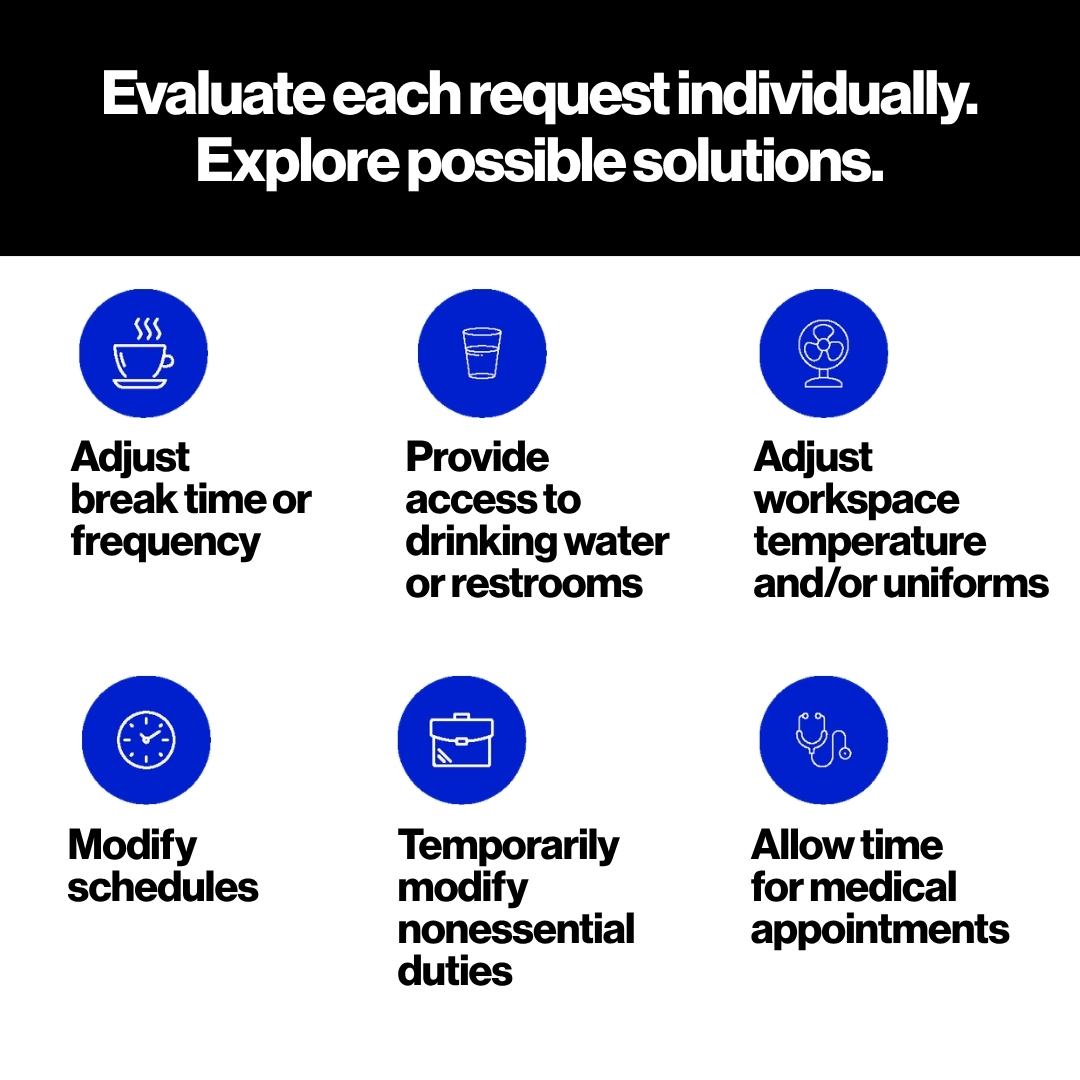
Train your Human Resources (HR) staff to respond to an employee request by focusing on their medical condition and work-related limitations. Explore possible solutions that might include:
- Adjusting break timing or frequency
- Providing access to drinking water or restrooms
- Adjusting workspace temperature or providing a fan
- Modifying schedules
- Temporarily modifying nonessential duties
- Allowing time for medical appointments
- Adjusting uniforms or other clothing requirements when feasible
Evaluate each request individually. For example, an accommodation appropriate for an administrative employee may not work for a teacher, laboratory employee, or campus safety officer.
Do not automatically reject the requested adjustment.
Train Managers
Supervisors may receive the first indication that an employee has an issue. Train your supervisors to recognize a potential accommodation or leave request and promptly make a referral to HR rather than attempting to decide independently whether the symptoms are serious enough.
Managers should not joke about menopause, question an employee’s competence because of symptoms, suggest retirement, or share an employee’s medical information or accommodation request with colleagues.
Remind managers that retaliation is forbidden and tell employees where they can report discrimination, harassment, and retaliation.
Coordinate Policies and Workplace Practices
Menopause does not require a separate institutional policy. Instead, examine how existing policies may need to be adjusted by HR or your legal counsel and whether any of the policies need to directly address perimenopause or menopause-related conditions.
Review menopause-related accommodation and leave requests in relation to all applicable institutional policies. Depending on the facts, the employee may have rights under the FMLA, ADA, state or local law, a collective bargaining agreement, or other policies.
Avoid treating attendance rules as automatic. If an employee has recurring medical absences, HR should consider whether a leave or accommodation process is triggered before discipline occurs.
Review Employment Decisions
Review consequential employment decisions carefully when menopause-related symptoms, absences, or accommodation requests are involved. Before denying an accommodation or medical leave, imposing discipline, or terminating employment, involve HR and legal counsel.
Ensure your practices include:
- Documenting accommodation requests
- Noting the information considered in the decision
- Considering available alternatives
- Confirming your response
- Stating the reasons for the decision
Consistent documentation can help demonstrate that decisions were based on legitimate job requirements rather than assumptions about sex, age, or health.
Adjust Workplace Conditions
Review your workplace conditions. Educational institutions have varying work environments including classrooms, kitchens, laboratories, maintenance areas, offices, and outdoor worksites.
Access to temperature controls, hydration, restrooms, and breaks can vary substantially among employees. Consider whether environmental adjustments are needed to accommodate employees experiencing menopause symptoms. These changes may benefit all employees in an area.
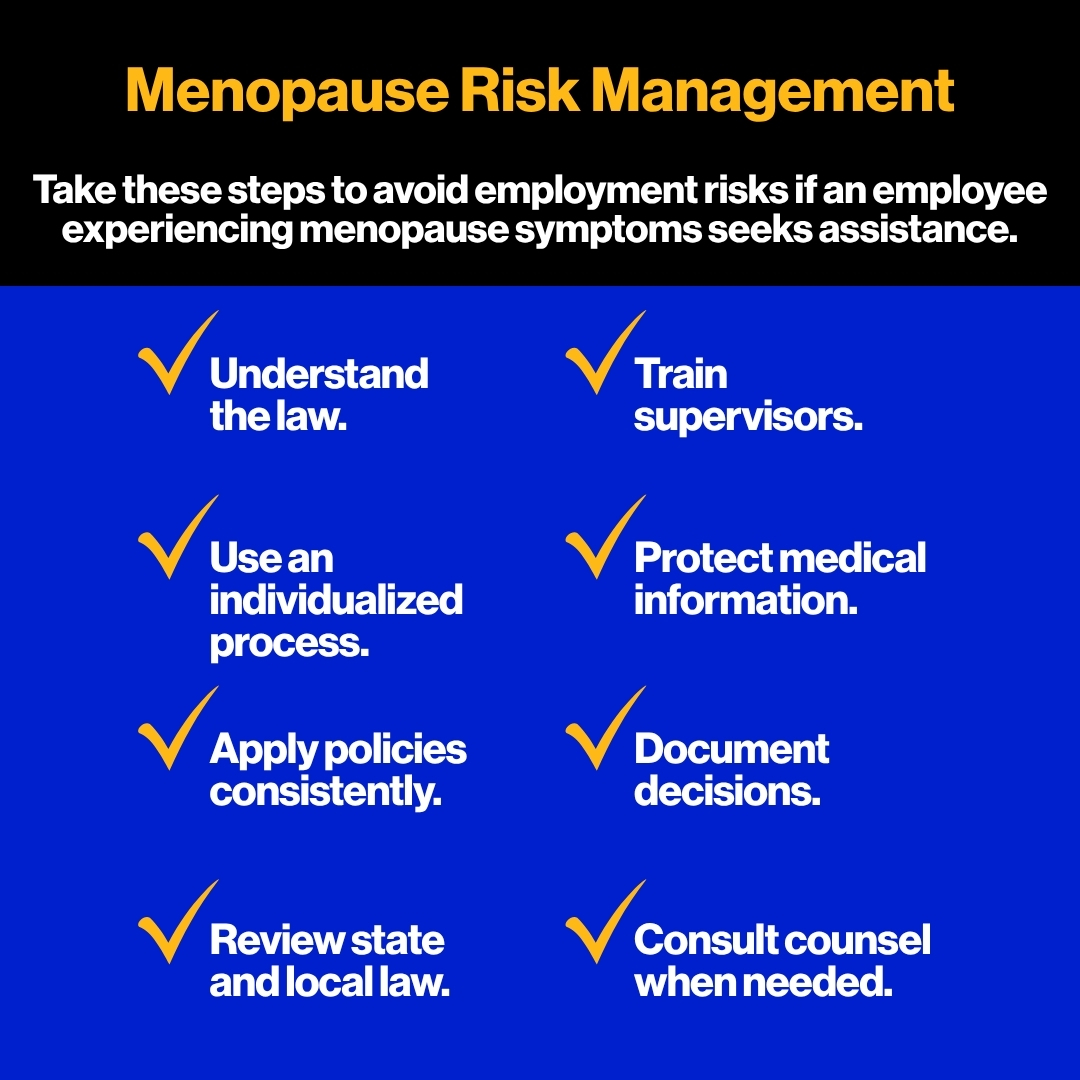
Menopause Risk Management
More From UE
Nondiscrimination and Accessibility Resource Collection
Additional Resources
National Institute on Aging: What Is Menopause?
Department of Labor: FMLA Serious Health Conditions
Rhode Island Commission for Human Rights: Menopause Accommodation Notice
Saul Ewing: Illinois Expands Workplace Protections for Menopause-Related Conditions
About the Author
-

Heather Salko, Esq.
Manager of Risk Research
Heather oversees the development of risk research publications. Her areas of expertise include employment law, Title IX, and student mental health. Before joining the Risk Research team, she practiced employment and insurance coverage law and handled UE liability claims for more than a decade.