
Predictive Maintenance on Campus
Many K-12 schools, colleges, and universities must balance reactive repairs with scheduled preventive maintenance. Deferred maintenance — regardless of whether it involves repair or preventative projects — can push facilities teams into a cycle in which emergency work consumes staff time and budget that could have supported planned work.
Predictive maintenance adds a more targeted option by using indicators such as:
- Temperature
- Vibration
- Pressure
- Runtime
- Energy use
- Repeated work order patterns
These indicators can help identify emerging problems, allowing your institution to make a reasoned determination as to when maintenance should occur.
Predictive maintenance can help reduce emergency repairs, protect safety, and limit disruption to teaching and residence life.
A disciplined predictive maintenance program can help your institution move from “fix it when it breaks” to “address it before it disrupts campus.” That shift can reduce loss potential, improve operational resilience, and make facilities decisions easier to defend.
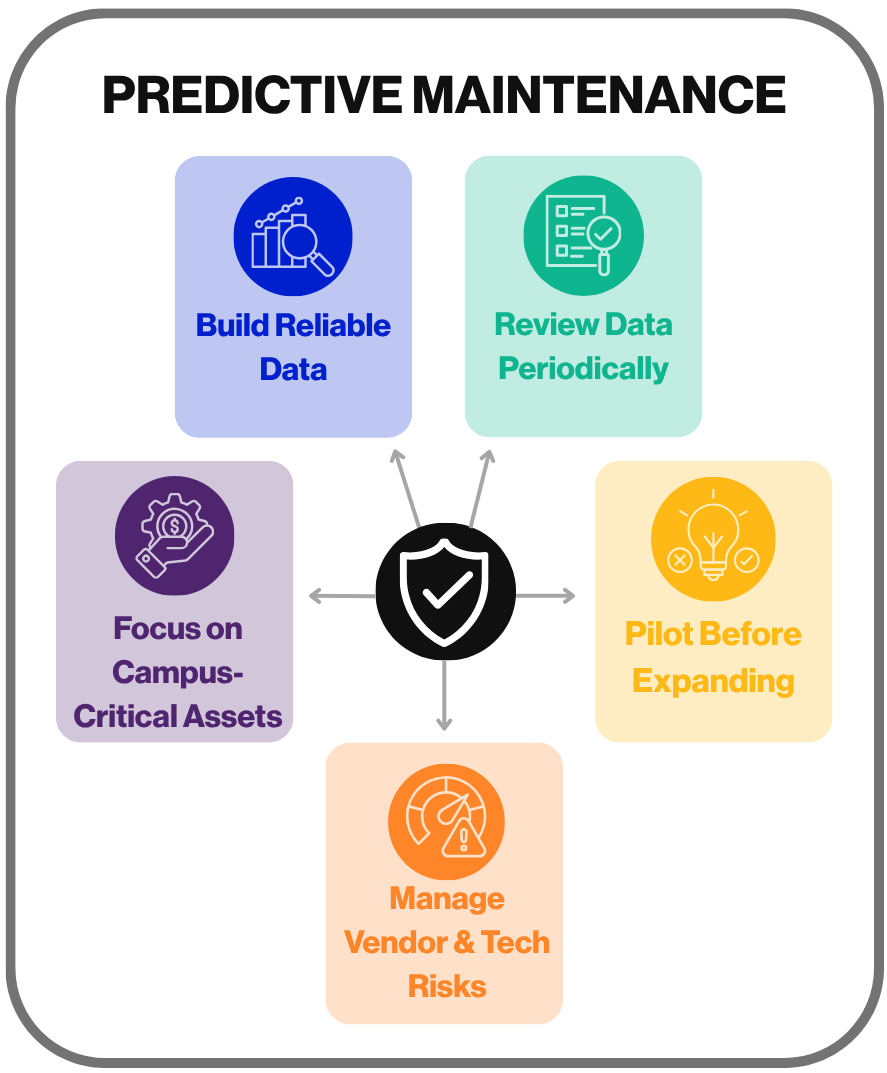
Focus on Campus-Critical Assets
Predictive maintenance uses data from sensors, building systems, maintenance records, and analytics to identify when equipment or infrastructure is likely to fail.
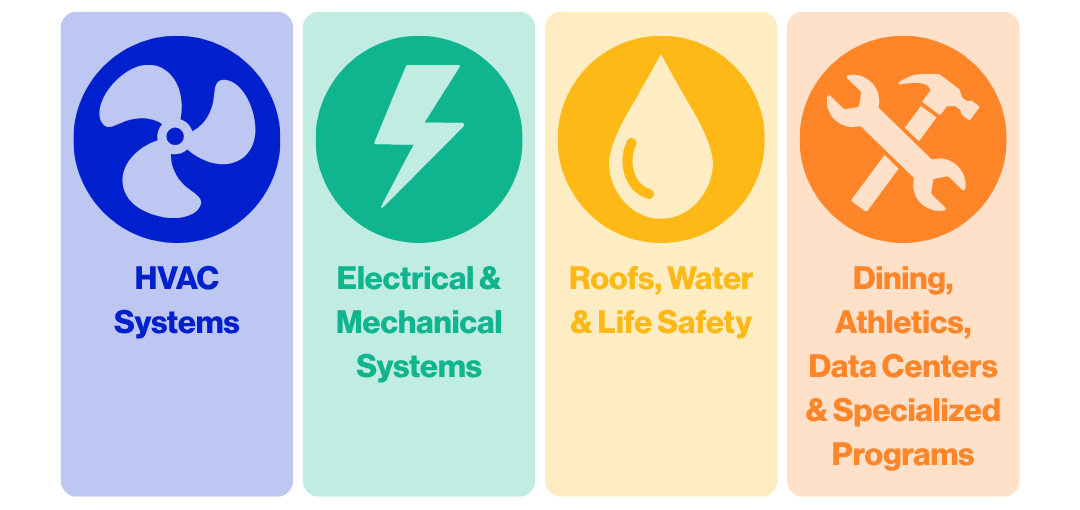
Start with systems where any large-scale failure could create safety, operational, compliance, or reputational risk. These may include:
- Heating, ventilation, and air conditioning (HVAC) systems serving residence halls, laboratories, server rooms, research spaces, or clinical areas
- Electrical switchgear, generators, elevators, boilers, chillers, and pumps
- Roofs, water intrusion points, life safety systems, and critical plumbing
- Equipment supporting dining, athletics, data centers, animal care, or specialized academic programs
Predictive tools are often most useful where failure would be expensive, dangerous, disruptive, or hard to repair quickly. Not every asset needs sensors or to be part of your predictive maintenance endeavor. Some low-cost, low-consequence equipment can remain on a preventive or reactive schedule.
Build Reliable Data
The value of predictive maintenance depends on data quality. Before buying new monitoring tools, work with representatives of facilities, finance, information technology, business office, and procurement to confirm that your institution has:
- An accurate inventory of buildings and other assets
- Standard work order categories
- Maintenance history by building and asset
- Defined priority levels for work orders
- Consistent closeout notes and failure codes
- Access to relevant building automation system data
Many institutions use a computerized maintenance management system (CMMS) to schedule work and track maintenance. Structured work orders, labor logs, and condition assessments can support predictive modeling and benchmarking.
Review Data Periodically
Create a cross-functional review group and process for high-risk assets. Depending on the asset and exposure, participants may include representatives of facilities, finance, campus safety, residence life, research leadership, information technology, business office, accessibility staff, and risk management.
Periodic reviews can be especially useful before peak-risk periods such as back-to-school, graduation, winter weather, severe heat, and major campus events.
Pilot Before Expanding
A predictive maintenance effort does not require a campus-wide technology overhaul. That could be prohibitively expensive. Instead, start by identifying your top facility failure scenarios and the assets most connected to them. Then determine what data you already have, what data you need, and who must act when the data shows emerging risk.
A limited pilot might focus on one item from your top facility failure scenario list, such as a chiller plant, high-value HVAC equipment, or electrical equipment in one campus zone. Define success indicators before implementation, such as:
- Fewer emergency work orders
- Reduced downtime
- Avoided overtime
- Improved parts planning and energy savings
- Better documentation of high-risk assets
Including risk management professionals in designing the pilot can help connect facilities metrics to institutional exposures such as student relocation, research loss, inaccessible buildings, indoor air quality complaints, event disruption, or business interruption.
Manage Vendor and Technology Risks
Many predictive maintenance programs rely on sensors, cloud platforms, analytics vendors, or artificial intelligence (AI)-enabled tools. Before adoption, thoroughly review contracts and data collection and management practices with representatives from procurement, information technology, legal counsel, business office, and risk management. Ensure any AI-enabled tools align with your institution’s AI use policy.
When reviewing technology tools for predictive maintenance programs, consider:
- Data ownership and access
- Cybersecurity and network segmentation
- Integration with existing CMMS or building automation systems
- Notification, escalation, and emergency response procedures
- Insurance, indemnity, and limitations of liability
- Staff training and documentation duties related to implementation
Additional Resources
About the Author
-

Melanie Bennett, Esq., ARM-E
Senior Risk Management Counsel
In her role on UE’s Risk Research team, Melanie dives into timely topics affecting education. Her areas of expertise include protecting minors, enterprise risk management (ERM), technology accessibility, and athletics. Prior to joining UE, she interned at the U.S. Department of Education’s Office for Civil Rights. Melanie serves on the Higher Education Protection Network’s (HEPNet’s) Board of Directors.